


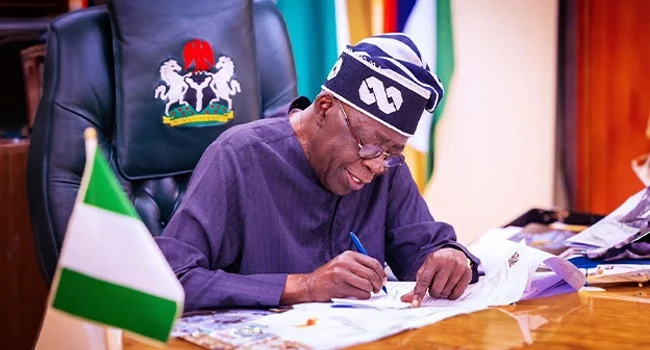
President Bola Tinubu has once again stirred the political landscape in Abuja by forwarding a fresh list of non-career ambassadorial nominees to the Senate, intensifying the diplomatic reshuffle that many analysts already describe as one of the most significant foreign policy overhauls in years. Tinubu continues to move with urgency as he repositions Nigeria’s foreign missions and recalibrates the nation’s global presence. His latest move signals a broader strategy that stretches beyond routine appointments and dives into the heart of Nigeria’s long-term diplomatic ambitions.
During Thursday’s plenary session, Senate President Godswill Akpabio read the President’s new letter on the chamber floor, and the atmosphere instantly shifted. Lawmakers leaned forward, eager to hear the latest names on the list—a list that showcased a blend of loyal technocrats, security veterans, political figures, and long-standing allies. The President’s nomination of several high-profile figures, including the immediate past Sole Administrator of Rivers State and former Chief of Naval Staff, Ibok-Ete Ekwe Ibas; former presidential aide, Ita Enang; former Imo State First Lady, Chioma Ohakim; and former Minister of Interior and former Chief of Army Staff, Abdulrahman Dambazau, immediately sparked conversations about Tinubu’s choice of strategy.
Tinubu, in his letter, urged the Senate to act swiftly and give priority consideration to the nominees so Nigeria could fill its crucial diplomatic offices without delay. He emphasized that Nigeria must maintain strong representation across key global capitals and multilateral institutions. His message carried urgency, not only because several missions remain without substantive ambassadors but also because Nigeria currently navigates complex global challenges, ranging from security issues to economic diplomacy, energy negotiations, trade partnerships, and climate commitments.
Shortly after reading the letter, Akpabio referred the list to the Senate Committee on Foreign Affairs and directed its members to commence screening immediately. He ordered the committee to return within one week with a full report and recommendations. The Senate President stated that Nigeria cannot afford diplomatic gaps at a time when foreign governments continuously re-evaluate their alliances, re-draw economic maps, and expand regional influence. The Senate seemed aligned with this vision, and discussions continued even after Tinubu’s letter concluded.
YEPS earlier reported that President Tinubu recently sent the names of 32 ambassadorial nominees to the Senate for confirmation, only days after transmitting an earlier batch of three nominees. The President continues to expand the roster as he distributes responsibilities across various regions of the world. Analysts believe that the President has taken a more hands-on involvement in diplomatic restructuring than many of his predecessors. His list of nominees includes diverse figures who can strengthen Nigeria’s foreign representation in strategic regions.
Among the earlier list of 32 were the former chairman of the Independent National Electoral Commission, Mahmud Yakubu; political commentator and former Presidential aide Reno Omokri, who represents Delta; former Enugu State Governor Ifeanyi Ugwuanyi; and several other notable figures whose careers extend across politics, business, diplomacy, and civil service. The nomination of Reno Omokri drew widespread interest online and offline because of his active involvement in political commentary and his vocal advocacy on global social issues, especially concerning Nigerian diaspora communities and human rights.
In two separate letters addressed to the Senate President, Tinubu urged the Senate to screen and confirm 15 nominees as career ambassadors and 17 as non-career ambassadors. These letters, according to Presidential adviser Bayo Onanuga, highlighted the President’s desire to accelerate the process. The Special Adviser explained in a statement titled “Tinubu Nominates 32 Additional Ambassadors” that the President wants highly competent individuals to take on these diplomatic roles without delay. According to him, Tinubu carefully reviewed each nomination and considered how each individual’s background aligns with Nigeria’s foreign policy objectives.
Onanuga also emphasized the gender inclusion reflected in the nominations. He stated that the President placed four women on the career ambassadors’ list and six women on the non-career list, marking a deliberate attempt to improve female representation in Nigeria’s diplomatic corps. This move follows growing advocacy for broader gender balance within government agencies and international organizations. Supporters of the administration praised this development and argued that more women should represent Nigeria on global stages, where their voices can influence policy, diplomacy, culture, and international cooperation.
Across Abuja, political conversations intensified as citizens, party members, analysts, and diplomats evaluated what these ambassadorial nominations signify. Tinubu’s supporters argued that the President demonstrates strategic foresight by choosing individuals who understand national security, governance, development, and geopolitical trends. Critics, however, questioned whether the President simply rewarded political loyalty, although many acknowledged that several names on the list carry decades of technical experience. The debate revealed the broader tensions that often accompany high-profile federal appointments.
Tinubu’s nominees will represent Nigeria in critical countries with whom the nation maintains strong bilateral ties. According to the Presidency, the new ambassadors will likely assume positions in global powerhouses such as China, India, South Korea, Canada, Mexico, the United Arab Emirates, Qatar, South Africa, and Kenya. The President also plans to assign ambassadors to Permanent Missions at the United Nations, UNESCO, and the African Union, enabling Nigeria to exert stronger influence in global decision-making arenas.
These diplomatic postings align with Nigeria’s renewed vision for stronger global partnerships. As Africa’s largest economy and one of the continent’s most influential political actors, Nigeria must strengthen its presence at the global table. Energy tensions, global inflation, currency reforms, technology exchange, migration issues, climate finance, and international trade now shape the agendas of many nations. Nigeria seeks to reposition itself, not only as a participant but as a major contributor whose voice carries weight. Tinubu clearly understands this, and his ambassadorial nominations reflect his desire to plant experienced hands in these diplomatic roles.
Back in the Senate chamber, Akpabio and lawmakers began internal preparations for the screening exercise. Senators frequently express concern about appointing individuals who lack diplomatic background, but they also acknowledge that Nigerian foreign missions benefit from a blend of career diplomats and political ambassadors. The career diplomats typically handle technical and procedural aspects of diplomacy, while political appointees bring visibility, influence, and direct access to top government officials worldwide. Tinubu appears to embrace this balance.
Political analysts in Abuja predict that the Senate will likely confirm most of the nominees, especially because the President currently maintains strong support in the upper chamber. Many senators believe that the President’s diplomatic agenda aligns with the nation’s broader interests. Some lawmakers, however, hinted that they will question nominees about Nigeria’s current global image, challenges with consular services, and the need for improved diaspora engagement.
The diaspora community remains one of Nigeria’s strongest assets, contributing billions of dollars annually through remittances and establishing growing networks in education, business, entertainment, and technology. Many Nigerians living abroad continue to demand better support from embassy officials, including faster passport processing, improved emergency assistance, more transparency, and better coordination with local authorities in host countries. Tinubu’s new ambassadors will face immense pressure to strengthen these areas, and the Senate might bring these concerns forward during the screening.
Outside the National Assembly, citizens reflect on the broader implications of the President’s diplomatic overhaul. Nigeria faces serious internal and external challenges. The economy struggles under inflationary pressure, insecurity across many states disrupts livelihood, and the nation seeks stronger investment commitment from the global community. Tinubu aims to use diplomacy as one of his most important tools for securing a better economic outlook. His administration continues to court global investors while negotiating pathways for foreign companies to expand operations in Nigeria.
The President’s ambitious diplomatic agenda also intersects with regional leadership. With ongoing political tension in West Africa—ranging from military coups to rising insurgency—Nigeria continues to play a central role in stabilizing the region. ECOWAS faces internal divisions, especially after the recent withdrawal of three member states. Nigeria must navigate these shifts carefully, and its ambassadors will serve as critical players in these negotiations.
Security also occupies a major portion of Nigeria’s diplomatic conversations with global partners. The country works closely with the United States, the United Kingdom, the European Union, and several Middle Eastern and Asian nations to strengthen counterterrorism strategies, intelligence sharing, and military cooperation. Nigeria seeks more technological support in areas such as drone surveillance, cyber-intelligence, border management, and anti-kidnapping operations. Tinubu wants ambassadors who understand the urgency of these challenges and who can leverage diplomatic channels to secure support.
Within Nigeria’s political space, Tinubu’s nominations also signal the strategic positioning ahead of 2027. The President continues to reward loyalists, expand influence, and assert control across key agencies and institutions. Political observers argue that diplomatic positions often play significant roles in election cycles, especially because ambassadors provide subtle influence in diaspora community engagements and foreign partnerships. Tinubu clearly understands the importance of these roles.
Despite public debate surrounding political appointments, the nominees themselves carry long histories of service. Ibok-Ete Ekwe Ibas served as Chief of Naval Staff and played crucial roles in maritime security. Abdulrahman Dambazau contributed to military leadership and internal security management. Ita Enang built a reputation as a legislative liaison and policy advisor. Chioma Ohakim has experience in public service and social advocacy. Each nominee brings a different flavor of experience that could strengthen Nigeria’s representation abroad.
As the Senate prepares to begin the screening exercise, the nation watches closely. Diplomacy shapes Nigeria’s external identity. It influences global partnerships, economic cooperation, and security collaborations. Tinubu continues to move with urgency because he understands that Nigeria faces a rapidly changing world—a world that requires strong diplomatic presence, clearer strategic direction, and representatives who can command respect in foreign capitals.
Nigeria stands at a crossroads. The country must repair its global reputation, strengthen its alliances, and navigate complex geopolitical trends. Tinubu’s ambassadorial nominees will represent the nation during a moment that requires clarity, diplomacy, and bold engagement. The Senate’s decision over the coming days will determine how Nigeria positions itself for the next decade.
For now, political actors, citizens, and observers wait. The diplomatic reshuffle continues. The stakes remain high. And President Bola Tinubu moves forward with a clear intention: position Nigeria boldly on the global stage and ensure the nation enters the next chapter with experienced hands guiding its foreign missions.